excision; or, an ode to the open-sourced
I spent the better part of an afternoon yesterday attempting to remove malware from my computer. This difficulty was compounded, significantly, by the fact that the malware in question was Windows 11-- the operating system I'd been running for the previous five years.
It's amazing how much we can store even in very small places; indeed, much of the technological advances of the last quarter century have been dominated by conversations about space-- transistors per unit area, and the subsequent meteoric rise in GPU power; consumer tech, specifically the ever-contracting and soon (presumably) vanishingly thin armada of MacBook Airs and iPhones; data compression. That last one is sort of a lie in the broad sense-- of course there is some serious promise in using ML architectures to get that done, and you can always argue that model distillation and transfer learning constitute some vague form of "compression" in the Platonic, abstract sense. But primarily I left it on because the little USB thumbdrive-- capacity 256 GB-- which I used to perform a clean installation of Ubuntu 25.10 on my half-decade old Huawei Matebook actually dwarved the capacity of said Matebook. A true David and Goliath story.
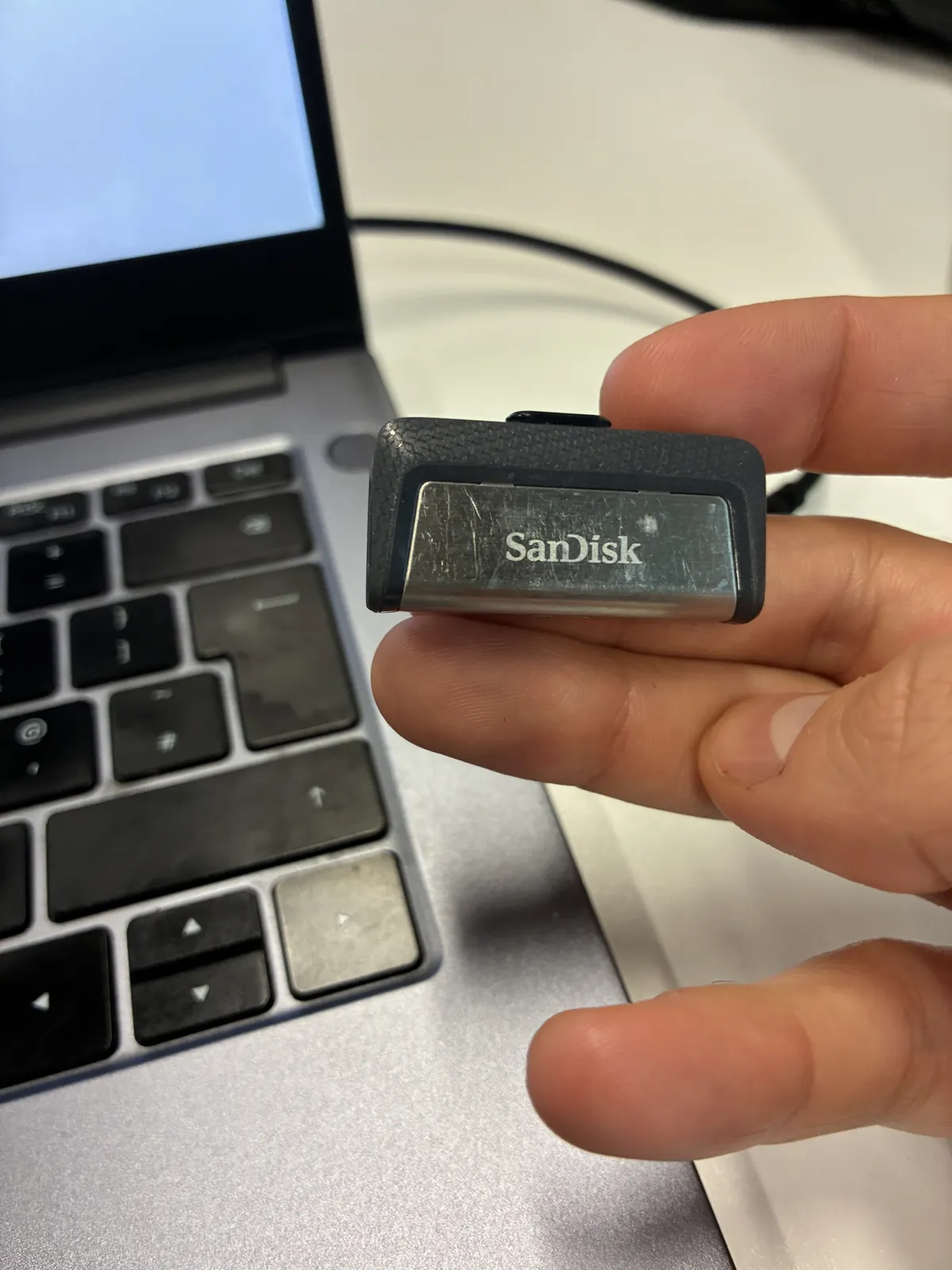
The little thumbdrive who could?
Or so I thought. It turns out that such a fracas is involved in installing, booting, and maintaining the increasingly dreadful Microsoft operating system that, when the smoke clears and the (glacial) boot-up subsides, I was left only with an anemic working C: drive capacity of around 80 GB, which, by post-Victorian standards, leaves little room and much to be desired. I imagine Babbage's Difference Engine could have given me a good run for my money.
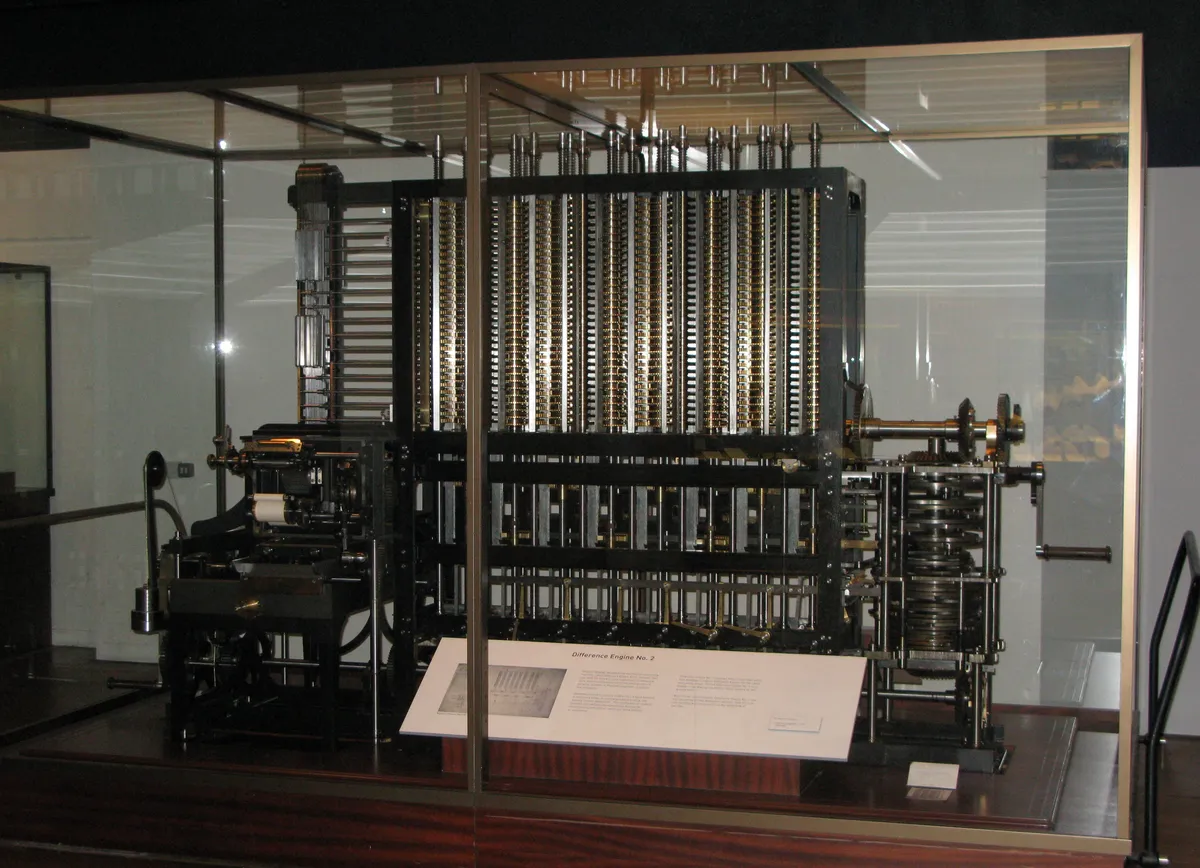
Babbage's engine.
Trojans
The truth is that installing Windows, now, is tantamount to voluntarily surrendering your hard drive, or flinging open the gates of Troy, taking a look inside the Horse and, despite the ironclad Greeks you discover sharpening their spears with glimmering eye inside, welcoming it into the City with arms wide open before going off to grab some shut-eye with your door left unlocked.
Windows 11 is the ultimate Trojan. Indeed, with decades of varying forms of global hegemony and essentially universal penetration, Microsoft is a Methuselah of tech, its very longevity the sole bona fide that keeps it on the hard-disks, workplace desktops, and tablets of the consumer world. We welcome it happily and doubtlessly, with a credibility and naivete that it scarcely deserves. Unless, of course, you chose Apple-- or, even more intrepidly, Linux, a choice so utterly alien to all except the substratum for whom there is truly no alternative.
It took me 23 years to enter that substratum-- a little bit earlier if you count my time spent happily breaking things in the CLI of Apple's UNIX-based OS which made the transition to Linux an essential fait accompli. Then arrived the awkward point at which came the decision as to whether I should gut my remaining vestige of a bygone age, the age of using Windows-- repulsive-- and wiping the 8 GB RAM dinosaur who had survived four years of Cambridge and one-point-one of Oxford, who, under the increasingly backbreaking weight of a bloated Windows, had managed the Herculean achievement of surviving it. But the cracks were forming-- nothing worked as quickly or smoothly as it should have anymore, and every attempt to get something done-- installing proprietary software, building a few Python virtual environments, downloading a handful of packages on my Windows Subsystem for Linux (which, despite the label, barely simulates the experience of working on Linux, even as a subsystem, even as Linux)-- necessitated the deletion and removal of something (or somethings) elsewhere.
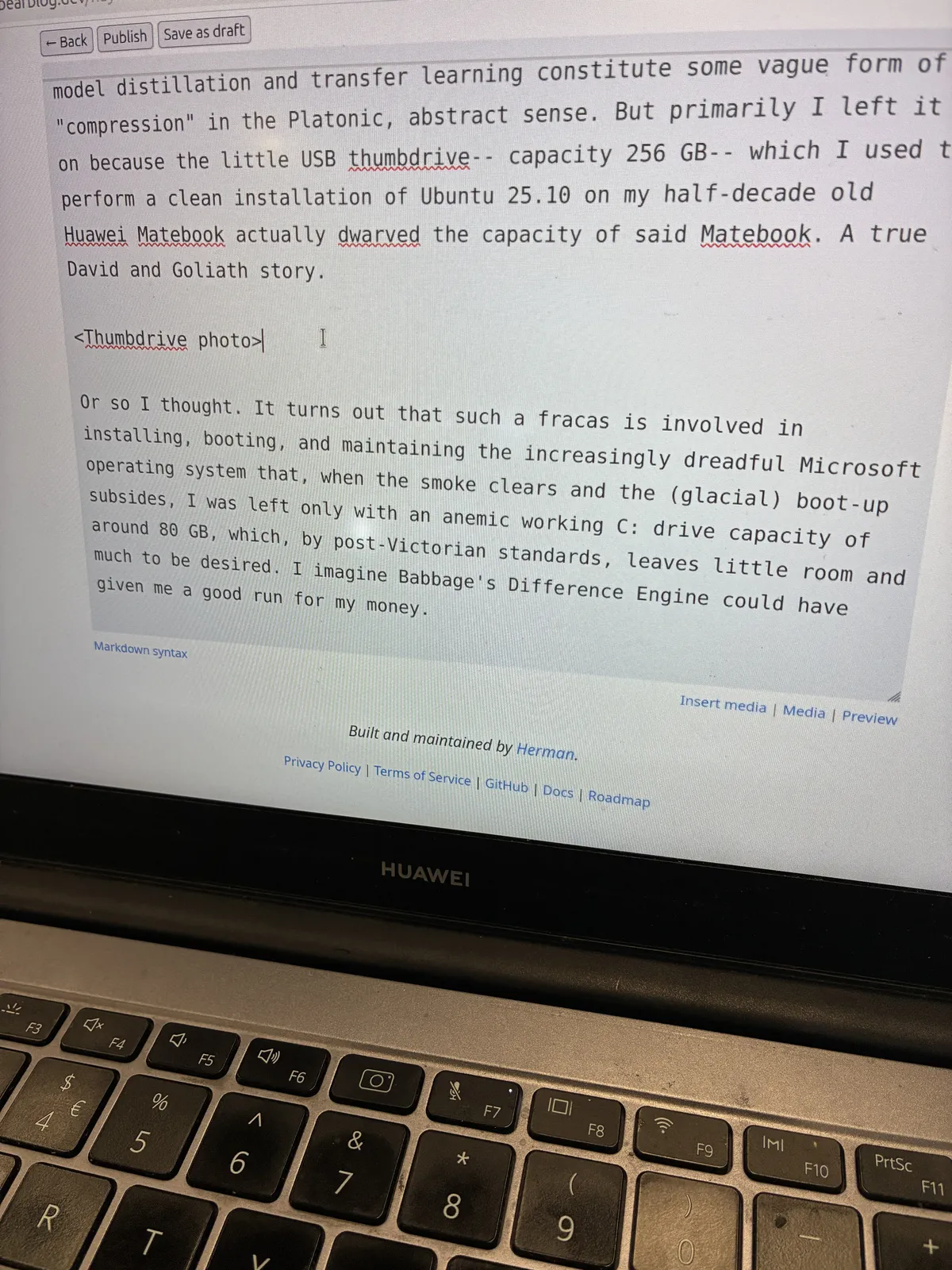
He survived Cambridge and Oxford-- almost more than I can say about myself.
Bring Up the Bodies
Scraping out the last remnants of Windows was like embalming the living body of a screaming man; at every step its nails digging deeper, defying attempts at booting in Safe Mode or being deleted, leaving me to keep scouring the recurring Microsoft mold as if from the grout of a damp kitchen. All this until I finally managed to get Ubuntu working at 7pm, by the Oxford High Street K6 Bus Stop under the orange glow of a streetlamp and in the shadow of the London Victoria bus, and later the University library, where an Eduroam outage (atop my latent frustration with excising Windows) nearly cooked what little sanity I still had.
It was utterly worth it. All things said and done, the new partition set up by Ubuntu left me with 500 GB of hard disk space (which is a larger number than 80), a preinstalled and self-consistent Python 3 distribution (as opposed to the 16 versions of Python that Windows had forced me to accumulate on my old OS), and, most importantly of all, lightness-- speed. After crossing the Emyn Muil with a knapsack full of cast iron pans, I was now featherlight, footloose, my only provision a small, leafy sachet of lemony lembas bread, moving twice as fast and half as tired1-- et cetera. Everything is doable with one, fast apt install or a quick invocation of vim or code .; everything is bash.
No more fucking zshell or cmd needed. Thank Christ.
Autobiographical Extrapolations
No one will realistically have any interest in the overwritten account of my fairly routine decision to install a Linux distribution on a laptop. Especially not among those in my field, who will probably be asking why it took me so long, or why I never invested money in a better computer.
The real fascination that this precipitated in my concussion-addled mind (ask later) was the (potentially stretched or overreaching) parallel to my own life and my decision to stop being a doctoral student in physics after doing it for a year (and then, a la previous post, after flirting with the idea of defecting to Engineering). The truth is that a lot of studying is malware; unnecessary overhead and academic bradycardia requiring years of personal sacrifice, financial hardship, and the subjugation of your intellectual curiosity in the interest of making political decisions about funding or publications.
I was always decent at physics; really, I was much better at mathematics and chemistry, and had for a long time failed to interpolate these skills to the natural middle-ground. But I was alright at it-- though not truly "great" in the traditional sense until much later on. What kept me pursuing physics was the complexity and expansive remit; everything falls under its purview. High-performance computing, machine learning, semiconductors, neurology-- there is always a natural place to slot in a physicist; or, at least, a serious conversation about the physics involved.
The problem is that by the time you have reached the level of studying for a PhD, your operating system is filled with years of accumulated trash, and what little bandwidth or capacity that remains need be directed at a problem that may be insufficiently interesting, profound, or impactful on the world at large to justify the sacrifice. Best, sometimes, to cleanly reboot-- stay agile, under- rather than over- specialized, with plenty of disk space left. Free.
Doing a PhD in physics after a Master's is the natural, unthinking next step-- like faithfully installing the latest hypercapitalist-cyberpunk microtransaction-pocked malware passing for a Windows update. It becomes easier and easier to lock yourself into a system of accumulating rather than pruning. The problem is that, like an SSD drive, you eventually run of of space, and hence capacity. At which point emerges the natural question as to whether there is a better way.
Here's to a life spent running Ubuntu rather than windows.
Readers are reminded that the author makes no attempts to shy away from the tiresome, obscure, or overwrought.↩